
Service · Data centres
Roof and Podium Commissioning for Data Centres
An independent commissioning authority for the waterproofing above your data halls. The design checked, the installation tested, and the roof monitored for as long as you own it.
Discuss your projectNobody independent is checking the roof
The power and cooling in a data centre are commissioned by an independent authority before the building is accepted. The roof above the data halls usually is not. It is designed by one party, priced by another, installed by a third and signed off by the people who built it.
Waterproofing defects then show themselves after handover, once the roof is covered by plant, paving or ballast and the contractor has left site. By that point the breach is hard to find and expensive to reach, and the water is already above live equipment.
Vector closes that gap. We act for the owner as commissioning authority for the roof and podium waterproofing: we set what the roof must do, check the design against it, help design the monitoring, check the tenders, inspect the work, test it before it is covered and stay on hand once it is in use.
What a commissioning authority does
A commissioning authority is appointed for the owner and is independent of the design team, the contractor and the manufacturer. The role runs through the whole project and rests on three working documents: the owner's requirements, the design team's response to them, and a commissioning plan that says what will be checked, when and by whom.
The service is structured on ASTM E2813, Standard Practice for Building Enclosure Commissioning, and adapted to UK practice. We have taken the independent, phased role from that standard. We do not claim compliance with it, and we do not follow its American test schedule.
At a glance
What runs when
Numbers match the seven stages below. Red is Vector's work. Black is the issues log.
Owner's requirements
Design peer review
Monitoring specification
Tender assessment
Site inspections
Leak testing
Issues and resolutions log
Sensor monitoring and data review
Roof inspections
Maintenance checks
Stage 7 is where most roofs are left alone. Vector keeps reviewing the data, inspecting the roof and checking the maintenance.
The service
Seven stages. One appointment.
- 01
Brief
RIBA Stages 1–2
We set the roof and podium requirements with you: service life, tolerance for water above the data halls, access and maintenance limits, and what you want monitoring to tell you.
You get: Owner's requirements for the roof and podium. Commissioning plan and budget.
- 02
Design peer review
RIBA Stages 2–4
Independent review of roof, podium and facade-interface drawings and specifications at each design stage. We work with your team to design the monitoring specification. Where a review comment is rejected, we ask for a written response that records the risk being accepted.
You get: Review reports. Risk register. Monitoring specification. Commissioning specification for the contract.
- 03
Tender
Procurement
We attend the pre-tender briefing and assess each bidder's quality plan, installer competence, exclusions and proposed substitutions, including any change to the monitoring.
You get: Tender assessment. Advice on addenda.
- 04
Construction QA
RIBA Stage 5
We review submittals, run pre-installation meetings, inspect at agreed hold points, keep the issues and resolutions log and chair the commissioning meetings.
You get: Inspection reports. A live issues log that the owner can read at any time.
- 05
Verification
Before covering
The first completed area is tested and signed off as the benchmark for the rest. Electronic leak detection on waterproofed roof and podium areas before they are covered. Sensors installed, commissioned and baselined. Water spray testing of glazing and interfaces.
You get: Test records, with defects, repairs and retests. Baseline monitoring data.
- 06
Handover and warranty
RIBA Stage 6
Close-out report and maintenance guideline. Inspections through the warranty period, the last one before it expires, so defects are raised while the contractor is still liable.
You get: Close-out pack. Pre-expiry defects report.
- 07
In use
RIBA Stage 7, for as long as you own the building
Vector stays on hand once the halls are live. We review the monitoring data, respond to alerts, inspect the roof and check that it is being maintained as the maintenance guideline sets out.
You get: Monitoring reports. Inspection reports. A maintenance record that supports the guarantee.
Sensors
Test it once. Then keep watching it.
A test, however thorough, describes the roof on the day. After it, the membrane is covered, plant is lifted onto it and other trades work over it for months. For a building where water above a hall is the risk that matters, a certificate from before all that happened is not enough.
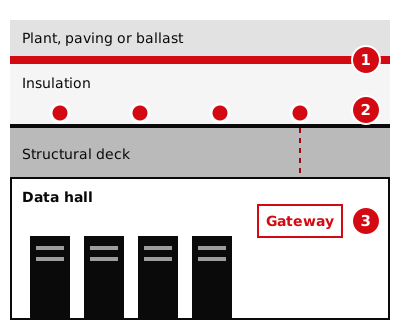
Sensors in the build-up give you the rest of the picture. They report moisture after the roof is covered, through fit-out and for as long as the building is in use. The aim is to find a leak while it is a damp patch in the build-up and a planned repair, not water in a data hall. We recommend them on every data centre roof we commission.
- 1
Test before covering
Electronic leak detection on the exposed membrane. Breaches are located, repaired and retested.
- 2
Sensors in the build-up
Report moisture once the roof is covered, through fit-out and in use. No penetrations through the membrane.
- 3
Alerts to people who can act
Who is told, how fast and what happens next is written into the monitoring specification. Vector reviews the data.
Typical warm roof shown. Sensor position and layout are set in the monitoring specification for each roof.
We help you design the monitoring specification
Sensors are only as good as the specification behind them. We work with your architect, roofing designer and M&E lead during design so that the specification in the tender documents settles:
- Where the sensors go, set against the risk in each area of roof: outlets, penetrations, plant bases, low points and the halls beneath
- What is measured and how often it is reported
- Alert thresholds, who is told and what happens next
- How the data reaches your team and the building management system
- Power and design life, so the system lasts as long as the roof
- No penetrations through the waterproofing
- Commissioning checks and the baseline taken at handover
- Who owns the data
In use
On hand after the contractor has gone
Most roofs are checked at handover and then left alone until something drips. Ours are not. Once the halls are live, Vector keeps looking after the roof on the owner's behalf.
Monitoring the data
We review what the sensors report, respond to alerts and tell you what a change means and what to do about it.
Inspecting the roof
Regular inspections, planned around the BS 6229:2025 recommendation of at least twice a year, and after any work on the roof.
Keeping it maintained
We check that outlets are clear, damage is repaired and the maintenance guideline is being followed, and we keep the record.
How we test the waterproofing
The first area is the benchmark. We do not ask for a separate mock-up. The contractor builds the first area of real roof, we inspect and test it, and once it passes it stays in place as the standard for everything that follows. If the build-up is untried, the contractor can provide an off-building sample for us to test as an extra.
Electronic leak detection, not flood testing. A flood test tells you a zone leaks. It does not tell you where, and it means holding water above the data halls. Electronic leak detection on the exposed membrane locates a breach, so it can be repaired and retested before the roof is covered. BS 6229:2025 recommends integrity testing before temporary protection goes down and again after it is removed, and we plan the programme around both.
No proprietary underlay required. Some specifications make leak testing depend on a conductive layer built into the roof. That ties the design to a material. Ours does not. We choose the test method to suit the build-up you want, so the waterproofing is selected on performance and not on what makes it testable.
Included
- Roofs over data halls, plant decks and ancillary buildings
- Podium decks and buried roofs
- Interfaces where the roof or podium meets the facade
- Water spray testing of glazing and those interfaces
- Monitoring specification, designed with your team
- Issues and resolutions log from design to close-out
- Inspections through the warranty period
- In-use data review, inspections and maintenance checks
Not included
- Full facade or cladding commissioning
- Airtightness and thermal performance testing
- Flood testing
- Building or testing off-site mock-ups as standard
- Design of the waterproofing, which stays with the design team
- Supply of sensors, which is a separate, optional appointment
Sensors, specified independently
Vector also supplies roof sensor systems, so we keep the two roles apart. The monitoring specification we help design is written so that any capable supplier can meet it, we assess whatever is installed against it, and we review the data whoever supplied the system.
If you want Vector to supply the sensors as well, that is a separate appointment, priced and reported separately, and the decision is yours.
What the testing can and cannot show
Every test has limits and our reports state them. An electronic leak detection result applies to the area tested, with the membrane exposed, on the day. A pass means no breach was detected under test conditions. It does not cover upstands and details above the tested plane unless those are tested separately.
A sensor reports moisture at its own location. A quiet sensor means no moisture reached that point, not that the roof did not leak somewhere else. That is why the sensor layout is set against the risk in the build-up, and why testing, monitoring and inspection are used together.
Why Vector
- Roofs and podium decks are our specialism: design review, leak detection, investigation and monitoring
- We find leaks on finished buildings, so we know which design and site decisions cause them
- Our leak testing is not tied to a proprietary underlay, so your specification is not either
- We stay with the roof in use, reviewing data, inspecting and checking maintenance
- No installer relationship and no warranty to protect
- Experience of sensor monitoring on data centre roofs. See the case study
Who this is for
- Data centre owners, operators and developers
- Project managers and employer's agents acting for them
- Architects and M&E leads who want the roof checked to the same standard as the plant beneath it
Not a data centre? Complete Roof Assurance covers design review, QA and monitoring for other building types, and a Waterproofing Design Review can be commissioned on its own.
Frequently asked questions
What is a commissioning authority for a roof?
An independent specialist appointed for the owner to check that the roof and podium waterproofing is designed, built and tested to do what the owner needs. Vector sets the requirements with you, reviews the design, helps design the monitoring specification, assesses the tenders, inspects the work, tests it and stays on hand once the building is in use.
Who appoints Vector?
The owner or developer, or the owner's project manager on their behalf. Vector is not part of the design team and has no commercial tie to the roofing contractor or the membrane manufacturer. Our reports go to the owner.
What happens after handover?
We stay on hand. We review the monitoring data, respond to alerts, inspect the roof and check that it is being maintained as the maintenance guideline sets out. BS 6229:2025 recommends inspecting a flat roof at least twice a year, and we plan the inspections around that.
Why sensors as well as testing?
A test describes the membrane on the day it was tested. The roof is then covered, plant is installed on it and trades work over it for months. Sensors in the build-up report moisture after the test, through fit-out and for as long as the building is in use, so a leak is picked up early.
Do you help write the sensor specification?
Yes. We work with your design team to set where sensors go, what they report, who is alerted and how the data reaches your team and the building management system. The result is a monitoring specification that goes into the tender documents.
Does the roof need a conductive underlay for leak testing?
No. Some specifications make testing depend on a conductive layer built into the roof, which ties the design to a particular material. We choose the test method to suit the build-up, so the waterproofing is selected on performance.
Do you flood test the roof?
No. A flood test shows whether a zone leaks but not where, and it puts a large volume of water above the data halls. We use electronic leak detection on the exposed membrane, which locates a breach so it can be repaired and retested, followed by sensor monitoring once the roof is covered.
Does the service cover walls and facades?
Only in part. The service is led by the roof and podium. On walls we review the interfaces where the roof or podium meets the facade, and we carry out water spray testing of glazing and those interfaces. We do not offer full facade commissioning.
Do we have to use Vector's sensors?
No. The monitoring specification is written so that any capable supplier can meet it, and we review the data whoever supplied the system. Vector also supplies sensor systems, but that is a separate, optional appointment and the choice is the owner's.
Is this ASTM E2813 commissioning?
The service is structured on ASTM E2813, Standard Practice for Building Enclosure Commissioning, and adapted to UK practice. It takes the independent, phased role from that standard. It is not a claim of compliance with it, and it does not follow the American test schedule.
When should we appoint?
At briefing, before the roof build-up is fixed. Sensor layout, data routes and test access are cheapest to settle while the design is still open. We can join later, but each stage missed reduces what can be checked.
Appoint the roof's commissioning authority early.
Tell us the scheme and the stage it is at. We will come back with a scope and fee within 48 hours.
Discuss your project