
Service
Permanent Leak Detection & Sensor Monitoring
Monitored waterproofing systems for peace of mind. If a car worth £30k will tell you about low tyre pressure, surely £30m buildings should tell you if there's a leak in your roof or basement.
Specify a system
By Ben Hickman, Technical Director
· 30 May 2026 · Updated 11 September 2026
Contributing author, CIRIA C817 (Blue Roofs) · contributing committee member, BS 8102:2022 revision
What permanent leak detection is
Permanent leak detection is a moisture-sensing system built into a roof or buried waterproofing build-up that monitors continuously for the life of the structure, rather than testing it once. Sensors sit beneath the waterproofing, report the conditions inside the build-up zone by zone, and raise an alarm when moisture arrives — within hours, at a known location, instead of months or years later when a stain finally appears on a ceiling.
Vector designs, commissions and monitors these systems. We hold no installation contracts and no sensor manufacturer relationship that pays us a margin, so the system specified is the one that suits the roof.
How the options compare
Four approaches get specified under the heading “leak detection”, and they are not alternatives to one another — two are continuous monitoring, two are one-off surveys. The distinction that matters most in a specification is whether anything has to pass through the vapour control layer or the membrane.
| Approach | Continuous or one-off? | Penetrations through VCL or membrane | Locates the breach | Best fit |
|---|---|---|---|---|
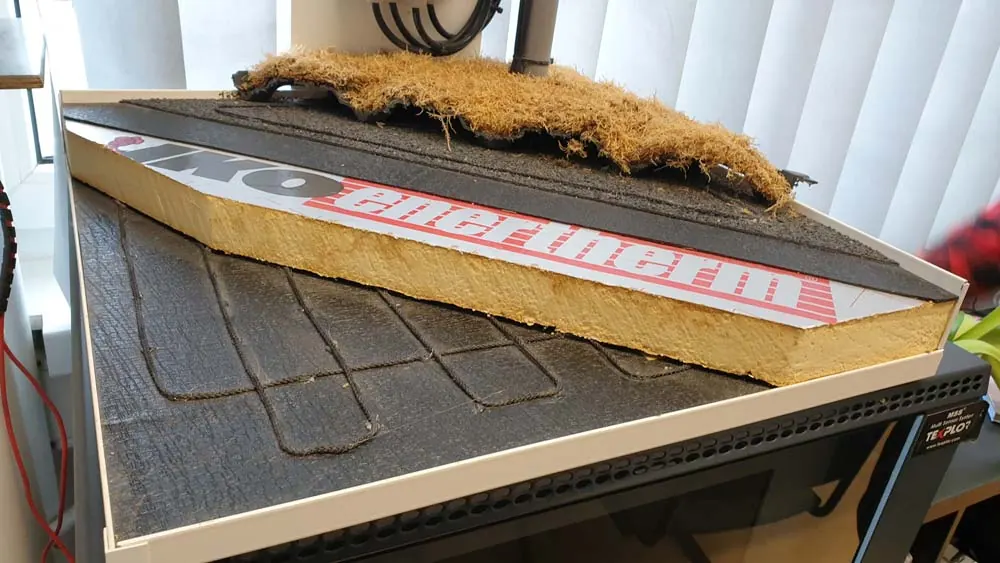
| Battery-powered sensor array | Continuous, 20+ years | None | Yes — to the sensor zone | Warm and hybrid decks, new build and refurbishment. Vector’s default. |
| Conductive grid (powered cable, carbon rope, aluminium tape) | Continuous, while powered | Power or conductive elements pass through one or both | Flags the circuit; the point of entry can be hard to resolve | Projects where mains-powered monitoring is already committed |
| Electronic integrity testing (HVELD / LVELD) | One-off test | None | Yes — precisely, to the breach | Handover, post-repair verification, before the membrane is concealed |
| Buried leak location (electrical field mapping) | One-off survey | None | Yes — to a highly localised area, through the overburden | Roofs already covered with ballast, paving, planting or PV |
Rows three and four are surveys we also carry out — see leak detection and condition surveys and buried leak location. For the full nine-method comparison, see flat roof leak detection: 9 methods compared.
Why main contractors engage us
The commercial case is clear.
- Compliance with current best practice — BS 8102:2022 Section 6.5 Note 2 accepts warm roof build-ups and loose-laid waterproofing on buried decks where permanent leak detection systems are employed, and CIRIA C817 Section 3.2.3 calls for permanent leak detection on warm blue roofs.
-
For heritage collections it is a requirement rather than an enabler:
BS EN 16893:2018
states that where assessment indicates a high risk of external water ingress, such as below-ground
accommodation, leak detection with an alarm shall be installed BS EN 16893:2018 · Clause 5.7.1 Protection against water - Design and materials
Leak detection with an alarm shall be installed.
Rooms where moisture is penetrating through the walls, floor, ceiling or openings shall not be used for collections at all. Where an assessment indicates a high risk of external water ingress, such as below-ground accommodation, forms of protection such as waterproof coatings or a bund shall be used, and equipment for removing ingress such as sump pumps shall be installed and checked frequently. The quoted sentence follows. This is a specification, not a code of practice: on a high-risk space, leak detection is a requirement. Extract quoted from BS EN 16893:2018, © BSI. Summary is Vector’s own wording. Checked against the published standard on 2026-09-11. , with flood sensors and audible alarms on drainage and pipework BS EN 16893:2018 · Clause 5.7.3 Protection against water - Drainage and piping workshall be regularly monitored and fitted with flood sensors and alarms that are audible outside the building
Storage, display and collection spaces shall not be constructed with water supply or drainage running through them, though provision shall be made for the rapid controlled removal of water accumulating during firefighting or sprinkler operation. The lowest level of a storage compartment shall be at least 150 mm above the floor, and drains in non-collection spaces shall be fitted with one-way valves to prevent backflow. The quoted requirement applies to drainage access points, pipework and other sources of water. Extract quoted from BS EN 16893:2018, © BSI. Summary is Vector’s own wording. Checked against the published standard on 2026-09-11. . - Quality assurance that allows determination of when and where the leak occurred — bringing clarity on which sub-contractor is responsible and significantly reducing remedial costs.
- Enhanced peace of mind and confidence for developers, insurers and occupants.
Case study
Vector Sensor Retrofit Case Study
Our approach
From design validation to lifetime monitoring.
Vector Validation
At RIBA Stage 3, we provide architects with a review and validation of their roof waterproofing design, picking up on common issues — falls, overflow outlets, interface details. Where appropriate we provide outline detail on a leak detection system at the same time.
Smart Leak Detection Design
Vector collaborates with the design team to develop a permanent leak detection system. We partner with several innovators (including Texplor and Sensor Innovation) to develop bespoke solutions for each situation. This becomes part of the specification at tender — see how to specify a smart, integrated leak detection system.
Installation & Quality Assurance
Vector trains the roofing contractor and oversees installation of the sensor array, providing comprehensive quality assurance on the waterproofing installation. We commission the system as soon as possible and monitor for defects through to practical completion and handover.
Robust monitoring
As well as monitoring the building element through a cloud portal with automated alarms, Vector
completes comprehensive bi-annual inspections BS 6229:2025 · Clause 8.2 Inspections A flat roof should be inspected at least twice yearly
In autumn once leaves have fallen, to verify the roof is clear and free draining and that outlets are not blocked; and in spring, to find and rectify weather damage. Green, blue and other specialist roofs are treated separately - they should be inspected in accordance with the designer’s original inspection plan. The clause then lists what an inspection covers, from ceilings and soffits through to rooftop installation mountings. Extract quoted from BS 6229:2025, © BSI. Summary is Vector’s own wording. Checked against the published standard on 2026-09-11. to provide compliance with
BS 6229 and manufacturer guarantee stipulations. If a leak does occur, Vector identifies the defect
location and ensures quality remedial measures are completed.
The benefits
Why this protects more than the roof.
- Stakeholder confidence
- Early awareness of defects reduces programme and cost impact
- A timestamped record that the building element stayed dry — available to insurers, funders and warranty providers if it is ever needed
- Enhanced reputation
CLT structures
Sensor Innovation have developed an outstanding system which measures wood moisture content (WME) wirelessly for 20 years. This allows for installation of sensors within concealed elements of timber structures — including under roof waterproofing.
These systems provide essential reassurance to developers, occupiers and insurers that decay is not a risk.
BS 6229:2025 now takes a notably cautious line on timber roof decks BS 6229:2025 · Clause 5.2 Roof slab/deck materials The use of cross-laminated timber (CLT) decks in flat roofs should be designed out wherever possible.
Where CLT is used, the clause calls for a finished fall of not less than 1:40, measures to protect the structure from moisture during construction, and roof finishes withheld until the timber is at a moisture content, through its full thickness, at which fungal decay does not occur - 20% is given as the recommended target. It closes by calling for inspection and testing regimes to be scheduled both during construction and throughout the service life of the building, so that decay can be caught early. Extract quoted from BS 6229:2025, © BSI. Summary is Vector’s own wording. Checked against the published standard on 2026-09-11. , which
makes the monitoring case on a CLT scheme easier to argue, not harder.
For the engineering detail behind sensor-based monitoring in mass timber, see our guide to monitoring moisture in mass timber, and the pillar structural engineer's guide to moisture management in mass timber and CLT.
Refurbishment projects
If you already have a leak and want to monitor it following remediation, we have retrofit solutions to monitor and provide stakeholder confidence that the issues are resolved over the long term.
Frequently asked questions
What is permanent leak detection?
Permanent leak detection is a moisture-sensing system built into a roof or buried waterproofing build-up that monitors continuously for the whole life of the structure, rather than testing it once. Sensors embedded beneath the waterproofing report a change in moisture at a known location, so a breach is flagged within hours of water arriving instead of months or years later when it appears at ceiling level.
What is the difference between permanent leak detection and electronic leak detection testing?
Electronic leak detection is a point-in-time test that proves the membrane was sound on the day it was tested. Permanent leak detection is continuous monitoring of everything that happens afterwards. They answer different questions and are complementary — we set the distinction out in full in permanent monitoring vs electronic integrity testing.
Which standards call for permanent leak detection?
BS 8102:2022 Section 6.5 Note 2 accepts warm roof build-ups and loose-laid waterproofing systems on buried decks where permanent leak detection systems are employed, which makes monitoring a compliance enabler rather than an upgrade. CIRIA C817 Section 3.2.3 calls for permanent leak detection systems on warm blue roofs. BS EN 16893:2018 goes further for heritage collections: clause 5.7.1 states that where assessment indicates a high risk of external water ingress, such as below-ground accommodation, leak detection with an alarm shall be installed. BS 6229 Note 2 to Clause 8.2 separately recognises that electronic devices are available to detect leaks.
How do the sensors report a leak?
Readings feed a cloud monitoring portal with automated alarms, so a moisture change at the membrane is flagged in hours rather than discovered years later. Vector also completes biannual inspections to BS 6229 Clause 8.2, which keeps manufacturer guarantees live.
Do the sensors need penetrations through the waterproofing?
No. The arrays we specify are battery powered, so there is no cable run through the vapour control layer and no penetration through the membrane — which is what usually causes friction with the roofing supplier’s warranty. Conductive grid systems that pass power or conductive elements through those layers are where that friction tends to arise.
How long do the sensors last, and can they be replaced?
A sensor inside a roof build-up cannot be reached without opening the roof, so service life is the governing specification test: the system has to last as long as the waterproofing above it. The wireless sensors we specify run for 20+ years on a single battery, and the arrays used on data centre roofs are rated for 30. Anything with a shorter life, or a dependency on wired power through the build-up, stores up exactly the intervention the roof should never need.
Can the system be used on CLT and mass timber buildings?
Yes. We specify wireless sensors that measure wood moisture content inside concealed timber elements — including under roof waterproofing — and run for around 20 years on a single battery. See CLT moisture monitoring.
Can sensors be retrofitted to an existing roof?
Yes. A 100 mm cylinder of insulation is cored out and replaced around the sensor, with a 100 mm membrane lap restoring the waterproofing above. Retrofit lets you monitor a roof after remediation, giving owners and insurers long-term confidence that the issue is resolved.
Related technical resources
BS 8102:2022 · BS 6229:2025 · BS EN 16893:2018 · How to specify an integrated system · CLT moisture monitoring · Data centre roofs — what to specify
Have the experts design your leak detection system.
Get an independent sensor strategy that protects the building for its full life.
Talk to Vector