
Technical Resource
CLT and Mass Timber — Moisture Monitoring in Modern Construction
Why CLT changes the moisture monitoring equation
Cross-laminated timber (CLT) and mass timber construction is growing rapidly in the UK, but these structures are acutely vulnerable to moisture damage. Unlike concrete, which tolerates intermittent wetting, CLT panels can suffer irreversible structural degradation if moisture content exceeds critical thresholds — and the damage often progresses hidden behind finishes until it becomes a major structural concern.
For a designer or asset owner, this means moisture sensing in CLT structures is not optional best practice — it is structural risk management.
The standards now addressing this
Multiple standards now address moisture risk in mass timber construction:
- BS 5250:2021 — The principal UK code of practice for moisture management in buildings, covering condensation risk and, in its diagnostic annex, the use of temperature and humidity data loggers to investigate moisture problems.
- BS EN ISO 6781-1:2023 — Covers thermal performance assessment using infrared thermography, a key diagnostic tool for identifying moisture ingress pathways in timber-framed and CLT buildings.
- PAS 2035:2023 — Requires a monitoring and evaluation plan for domestic retrofit projects PAS 2035:2023 · Clause 8.1.6 Medium-term improvement plan - monitoring and evaluation plan
The Retrofit Coordinator shall prepare a monitoring and evaluation plan that is appropriate for all proposed measures in the medium-term improvement plan.
At a minimum the plan includes an outline of the basic evaluation to be undertaken at the end of each retrofit stage. A note points to BS 40101 for further guidance on monitoring and evaluation. The clause requires a plan; it does not specify moisture monitoring or any particular sensor. Extract quoted from PAS 2035:2023, © BSI. Summary is Vector’s own wording. Checked against the published standard on 2026-10-07. , and refers to BS 40101 where further building-performance evaluation is required PAS 2035:2023 · Clause 13.5.1 Further monitoring and evaluationthe Retrofit Evaluator shall design a further monitoring and evaluation plan (if one does not exist already) with a defined duration, in accordance with BS 40101 for Preliminary Evaluation, Light BPE, or Standard BPE (including Investigative BPE elements)
This is the clause that links PAS 2035 to BS 40101. It applies only where further monitoring has been determined to be required under 13.3.1, and the plan must establish why performance differed from prediction, identify remedial work and capture learning. Annex A.5.1 adds that the Retrofit Evaluator carrying out further monitoring must be independent of the Coordinator, Assessor, Designer and installer. Extract quoted from PAS 2035:2023, © BSI. Summary is Vector’s own wording. Checked against the published standard on 2026-10-07. . Further monitoring is conditional, not universal PAS 2035:2023 · Clause 13.3.1 Levels of monitoring and evaluationTwo levels of monitoring and evaluation shall be carried out.
Basic evaluation applies to every completed domestic retrofit project. Further monitoring and evaluation applies only where basic evaluation shows outcomes significantly different from those intended, where unintended consequences are suspected, where the 8.1.6 plan stipulates it for the measures installed, or where the Retrofit Evaluator, Coordinator or client requests it. Further monitoring is therefore conditional, not universal. Extract quoted from PAS 2035:2023, © BSI. Summary is Vector’s own wording. Checked against the published standard on 2026-10-07. . - BS 40101:2022 — Provides a framework for building performance evaluation, including long-term monitoring of internal environmental conditions BS 40101:2022 · Clause 5.7.1 Internal condition monitoring - General
Internal environmental parameters shall be measured and data logged at intervals of no more than 30 minutes throughout the monitoring period.
Where the standard requires it, internal conditions are monitored for the 12-month BPE period using three core metrics: air temperature, relative humidity and CO2. Sensor positioning is set by Table 12 and accuracy limits are given (0.5 degC, 3% RH, 50 ppm). This is room-air monitoring for building performance evaluation, not moisture monitoring of the structure. Checked against a BSI Knowledge extract dated 8 March 2026; see file header. Extract quoted from BS 40101:2022, © BSI. Summary is Vector’s own wording. Checked against the published standard on 2026-03-08. . Its investigative toolbox recognises embedded fabric moisture sensors at vulnerable locations such as embedded timbers as a method the evaluator could recommend BS 40101:2022 · Clause Annex A, A.11.1.4 Investigative BPE toolbox - Moisture measurementembedded fabric sensors/probes - sensors isolated within building fabric measuring relative humidity (%) and/or moisture content (%), particularly at vulnerable locations, such as embedded timbers, insulation interfaces and junctions
The commentary says that where fabric moisture might be of particular concern the evaluator could recommend interstitial moisture measurement, listing retrofit work, new-build using hygroscopic materials such as timber frame and CLT, identified interstitial condensation risk, and evidence of moisture damage. Methods are gravimetric or non-destructive measurement, and embedded sensors recording time-series data through the 12-month period or longer. A note observes that sensors can be built into the fabric during construction. The verb is could recommend, and the context is an optional investigative element, so this is recognition of embedded sensing as a method, not a requirement for it. Checked against a BSI Knowledge extract dated 8 March 2026; see file header. Extract quoted from BS 40101:2022, © BSI. Summary is Vector’s own wording. Checked against the published standard on 2026-03-08. . Its requirements can inform a wider building-monitoring strategy, but it is not a dedicated standard for embedded CLT moisture sensors.
What Vector specifies for CLT structures
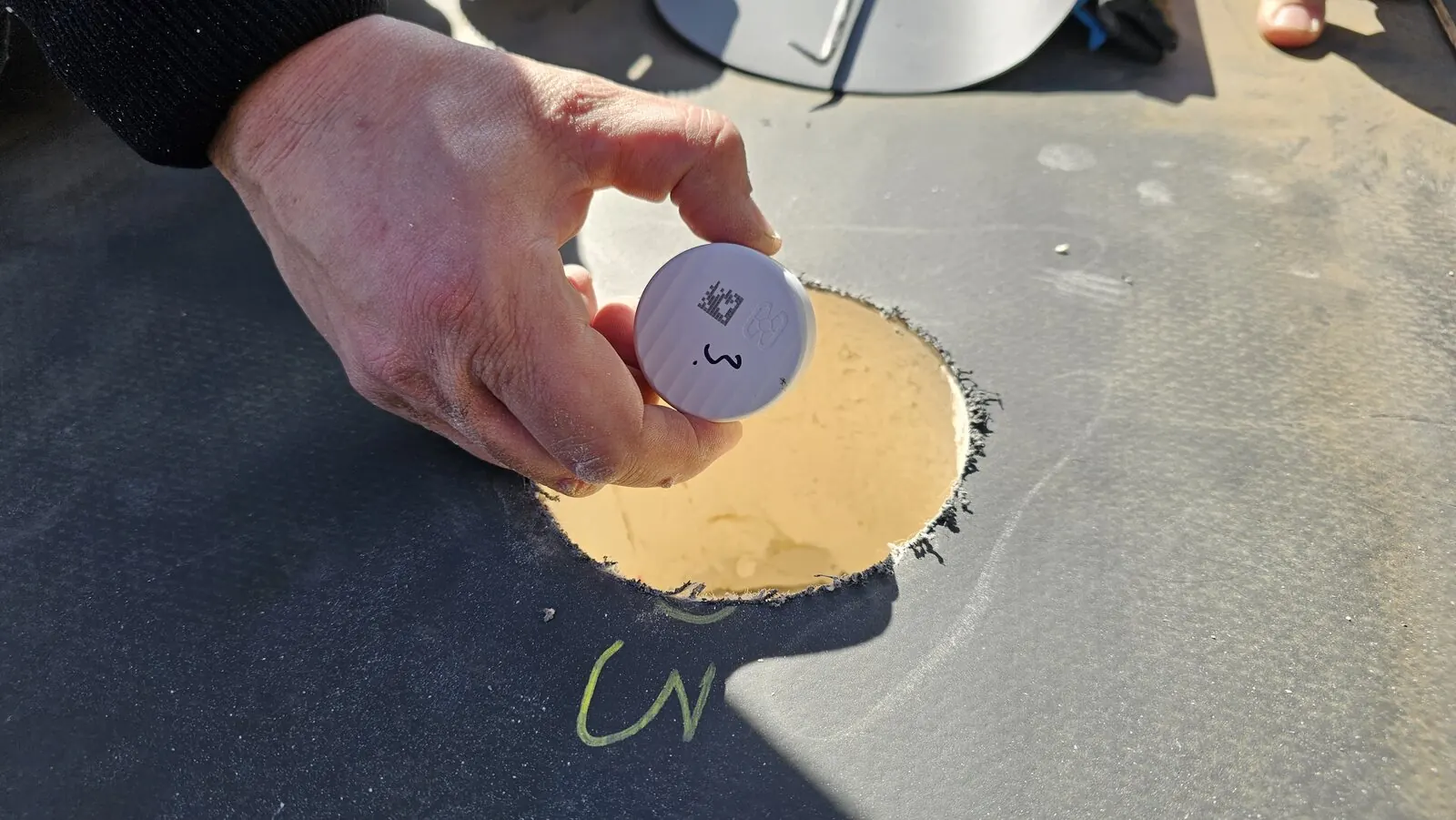
Vector designs sensor arrays for CLT moisture monitoring as part of a wider moisture-risk strategy, with monitoring frequency, sensor location and alert thresholds selected to suit the structure and project requirements, and data logging structured so that it can feed a building-performance evaluation where one is required. Sensors are placed at known moisture-risk interfaces — junctions with concrete or steel, exposed end-grain, service penetrations — with automated alerting when moisture content approaches structural thresholds.
For developers building in CLT, the cost of installing this monitoring during construction is a fraction of one remediation event. It is the structural moisture monitoring equivalent of a smoke detector — cheap to install, irreplaceable when something goes wrong.
Standards: BS 5250:2021, BS EN ISO 6781-1:2023, PAS 2035:2023, BS 40101:2022 | Publisher: BSI
Checked against current edition: PAS 2035:2023 on 7 October 2026; BS 40101:2022 clause extracts on 8 March 2026. Click any superscript to see the reference.
← Back to all Technical Resources | Permanent Leak Detection & Sensor Monitoring
Read more: our in-depth structural engineer's guide to moisture management in mass timber and CLT, plus detailed guides on safe moisture-content thresholds and monitoring methods.
← Back to all Technical Resources · Permanent Leak Detection & Sensor Monitoring