
Walk into any modern data hall and you’re surrounded by leak detection. Sensing cables snake under the raised floor, moisture probes sit beneath every chilled-water pipe, and the building management system knows about a drip almost before it lands. Then look up. Above the ceiling, above the services zone, sits the one building element that exists specifically to keep water out — and in most data centres, it’s the only part of the envelope with no monitoring at all.
That’s starting to change. We’re seeing integrated leak detection specified on data centre roofs more and more often, usually via the architect responsible for the roof waterproofing design. What we’re rarely seeing is any detail beyond that one line. “Integrated leak detection system” appears in the specification, and the questions that actually determine whether it works — what kind of system, where it sits in the build-up, what it means for the roof supplier’s warranty, and who looks at the data — get left for someone else to answer later.
This article is our attempt to answer them earlier, because later is expensive. If you have reached the point of writing the clause, see our companion guide to specifying a smart, integrated leak detection system in a roof build-up.
What “integrated leak detection” means on a data centre roof
An integrated leak detection system is a permanent moisture-sensing layer built into the roof build-up itself, beneath the waterproofing, that reports a breach continuously for the life of the roof. It is not the leak detection inside the data hall, and it is not a one-off test of the membrane. It is the roof telling you, in real time and at a known location, that water has arrived where it should not be.
Why the roof deserves the same attention as the data hall
The commercial logic of a data centre is uptime. The operator owes availability to its customers under service level agreements, and an interruption has consequences that go well beyond the cost of repairs. The industry’s own research bears out how expensive interruptions are: the Uptime Institute’s annual outage analysis consistently finds power problems to be the leading cause of impactful data centre outages — and electrical infrastructure is exactly what water ingress through a roof finds first. Switchgear, busbars, cable routes and plant don’t need a flood to cause a problem; they need a drip in the wrong place.
The distinctive thing about a roof leak, compared with a failed pipe fitting inside the hall, is that nobody is watching for it. Internal leak detection is mature, standardised and expected. The roof above it is usually silent — and a membrane breach can admit water for months before it shows itself at ceiling level, by which time it has travelled, saturated insulation, and made its entry point genuinely difficult to find.
Data centre roofs are not quite like other UK flat roofs
There’s significant American influence on the UK data centre market, and it shows in the roof build-ups. We see details that are more American than the UK roofing industry is used to — cement board appearing within the build-up, for example — and warm roof constructions are more common on data centres than in the wider UK market.
The roof is also a working platform in a way few other building types match. Photovoltaics, plant, cable routes and walkways all end up on top of the membrane, which means follow-on trades are on that roof after the waterproofing is complete — during construction and for the life of the building. This is the uncomfortable truth of large flat roofs generally, and data centres especially: even if the waterproofing was installed perfectly, things can go wrong afterwards. A dropped fixing, a dragged panel frame, a penetration added two years later. The membrane’s quality on handover day is not the question. The question is whether anyone will know when something changes.
The options: an electrical grid, or a sensor grid
Broadly, permanent leak detection within a roof build-up comes in two families.
| Conductive grid | Battery-powered sensor array | |
|---|---|---|
| What it is | Powered cable, carbon rope or aluminium tape forming an electrical grid within the build-up | Discrete moisture sensors arranged in a grid within the build-up |
| How it detects | Moisture changes the electrical behaviour of the grid | Each sensor reports the actual conditions in its own zone |
| Penetrations | Power or conductive material must pass through the vapour control layer or the waterproofing | None |
| Warranty friction | High — every penetration is a negotiation with the membrane supplier, and the same applies at day joints | Low — nothing passes through the membrane |
| Locating the breach | You know the grid has seen water; where it got in can be hard to resolve | Change shows up in a known zone |
| Service life in the roof | Depends on the power supply and the cabling | 30-year battery on the arrays we specify |
Battery-powered sensor arrays are the family we support, for the reasons in the right-hand column. Installation is straightforward during the roofing sequence, and there is nothing to negotiate with the membrane supplier.
The obvious question about batteries is life — and this is where data centre roofs differ fundamentally from data halls.
The replaceability test
Inside the hall, a failed sensor is a maintenance ticket. Someone walks over, unclips it, replaces it.
Inside a roof build-up, there is no walking over to it. A sensor buried beneath the membrane, insulation and whatever sits on top is, for practical purposes, entombed. You cannot pull it up and swap the battery without opening the roof — which defeats the entire purpose of a system installed to protect the roof’s integrity.
So the specification test for any in-roof system is simple: it has to last as long as the roof does. The sensors we work with carry a 30-year battery life, which means the array can be installed once, during construction, and be expected to serve the design life of the waterproofing above it. Anything with a shorter service life, or a dependency on wired power through the build-up, is storing up exactly the kind of intervention the roof should never need.
Warm roof or inverted roof — decide with monitoring in mind
By the time this decision is made, the die is largely cast. Architects are left with significant decisions around the thermal envelope, and those decisions dictate which roof build-ups are viable at all. Roofing suppliers will often push for an inverted build-up. Our position, where the project allows it, is a warm roof with an integrated sensor array: a build-up in which the sensors sit protected within the construction, the conditions above the deck are known, and a change anywhere in the roof announces itself.
This is precisely why timing matters.
When to bring this conversation into the project
The honest answer is: from the beginning of RIBA Stage 3. That’s when the thermal envelope strategy is being settled, when warm-versus-inverted is genuinely still open, and when an integrated leak detection layer can be designed into the build-up rather than negotiated into it. Come to the same conversation after the roof design is frozen — or worse, after the roof is on — and the options narrow to compromises.
What we need to advise usefully is modest: the roof GAs and the proposed build-up. From there we can lay out the realistic options, the interfaces with the waterproofing design, and what each choice means for the supplier warranty and the operator’s monitoring regime. This is exactly the ground our designing for sensor-based leak detection service covers.
Frequently asked questions
What is an integrated leak detection system in a data centre roof?
It is a permanent moisture-sensing layer built into the roof build-up itself, beneath the waterproofing, that reports a breach continuously for the life of the roof. It is distinct from the leak detection inside the data hall, which protects against internal sources such as pipework and cooling.
Can leak detection be retrofitted to an existing data centre roof?
Retrofit options exist — we’ve installed sensor systems on existing roofs — but the choices are narrower and the installation more involved than designing the array in from Stage 3. If you’re operating an existing facility, it’s worth a conversation; if you’re still in design, don’t let it become a retrofit.
Does an in-roof sensor array affect the roofing warranty?
This is the practical advantage of a battery-powered array: no penetrations through the vapour control layer or the waterproofing, so there is far less for the membrane supplier to object to. Conductive systems that pass power or conductive elements through those layers are where warranty friction tends to arise.
Is this instead of electronic leak detection testing?
No — they’re complementary. Electronic leak detection (ELD) is a point-in-time test that verifies the membrane’s integrity, typically at handover or after works; a sensor array is continuous monitoring for everything that happens afterwards. On a data centre we’d argue for both: test the membrane you’ve been handed, then watch it for the next thirty years. See our complete UK guide to electronic leak detection and the distinction set out in permanent monitoring vs electronic integrity testing.
How long do in-roof sensors have to last?
As long as the roof does. The arrays we specify for data centres carry a 30-year battery life, so they can be installed once during construction and serve the design life of the waterproofing above.
We already have EN 50600-aligned leak detection inside the facility. Aren’t we covered?
Internal detection protects you from internal sources — pipework, cooling, condensate. It tells you nothing about the envelope above you until water has already arrived inside. The roof needs its own answer.
Warm roof or inverted roof for a data centre?
Where the project allows it, our position is a warm roof with an integrated sensor array. Roofing suppliers will often push for an inverted build-up, which is why the decision needs making while the thermal envelope strategy is still open.
At what stage should this be decided?
From the beginning of RIBA Stage 3. To advise usefully we need the roof GAs and the proposed build-up.
Where the experience comes from
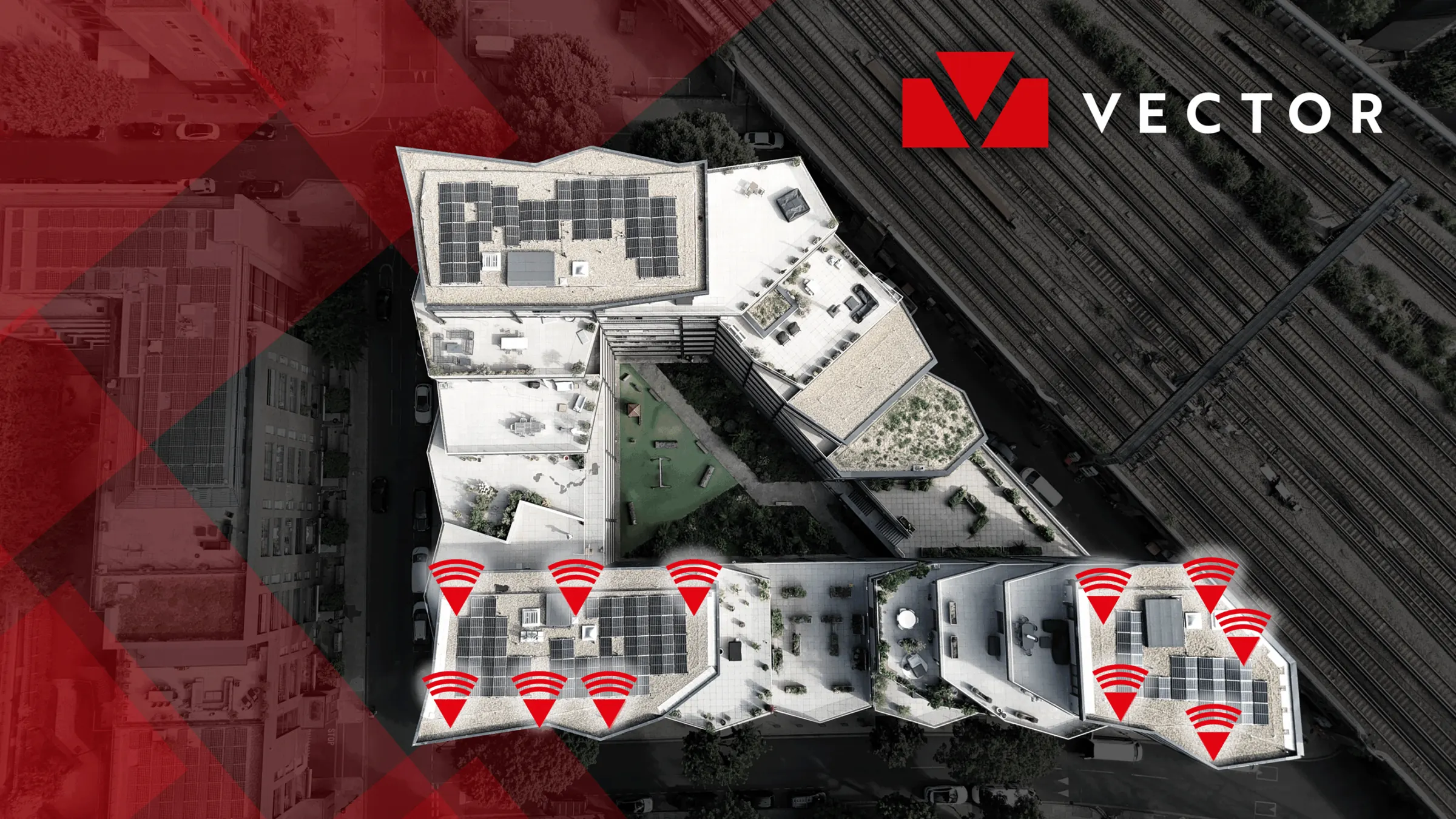
The sensor technology we specify comes from Sensor Innovation, whose arrays have been installed in numerous data centres across Europe. You can see how an installation goes in — 30-year sensors, zero membrane penetrations — in our data centre roof sensor monitoring case study. Vector’s role is the independent one: we don’t supply membranes and we don’t win either way on the build-up decision. We advise on whether, where and how monitoring belongs in your roof — and we’ll tell you when it doesn’t.
If you have a data centre roof at Stage 3 — or a specification that currently says “integrated leak detection” and nothing else — contact us with the roof GA and we’ll give you a free design review. You can read more about how continuous monitoring works on our permanent leak detection page.