
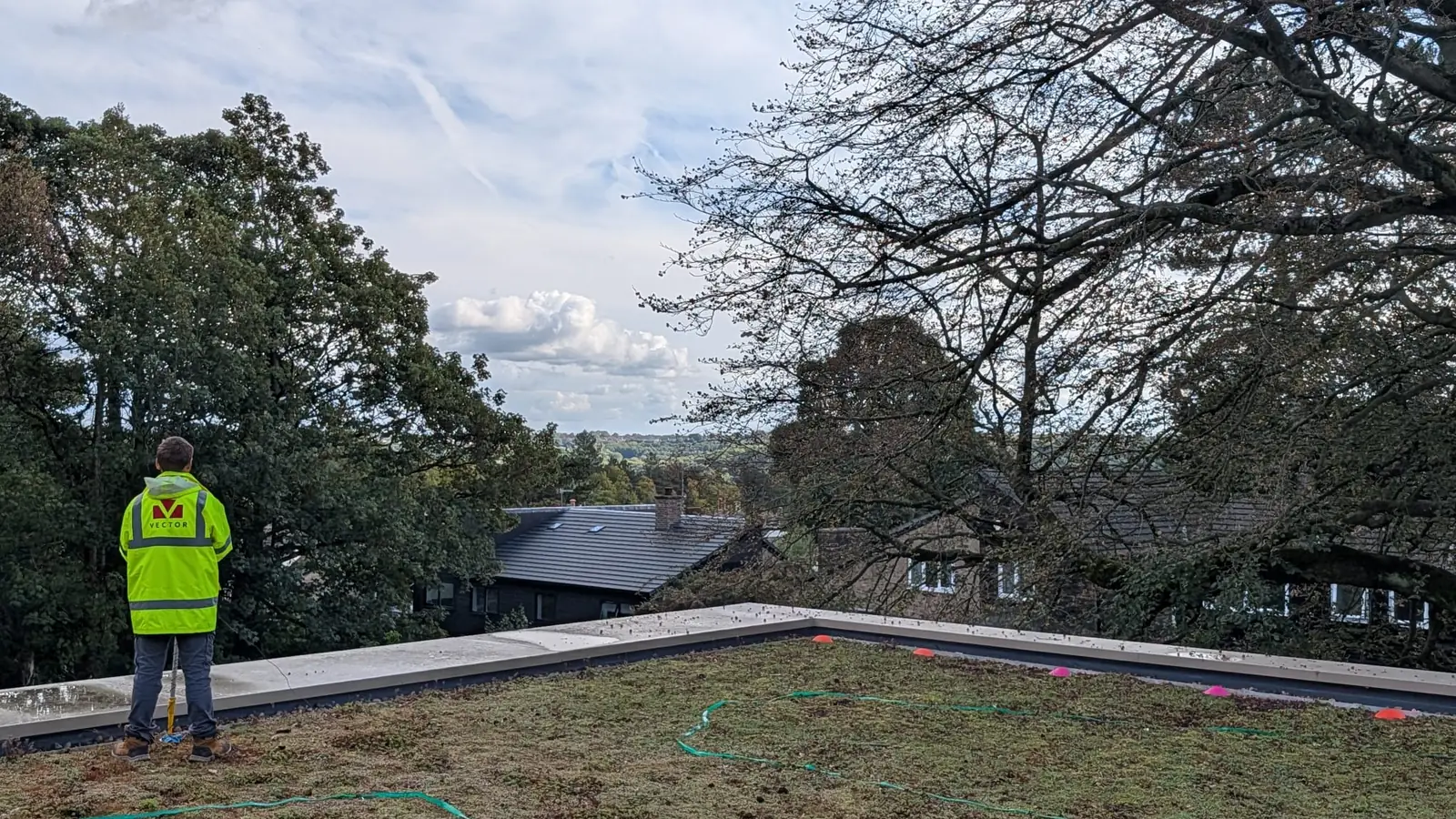
Once a waterproofing membrane is buried under a green roof, the leak detection methods that work on bare roofs do not. Visual inspection sees vegetation. Thermal imaging reads wet substrate. Dye and flood tests prove a leak without locating it. Conventional electronic leak detection needs a membrane it cannot reach. The breach is found through the build-up with a buried leak location survey, and the roof is kept from leaking again by proving the repair and, where the build-up allows, monitoring it.
Green roofs deliver real environmental benefits. They also create one of the most difficult leak detection problems in commercial roofing, and this page is the overview of that problem: why green roofs leak, why the standard methods fail, what works, and how to make the investigation the last one the roof needs. Each part links to a fuller page.
The green roof problem
You cannot see the membrane. You cannot reach it without lifting the planting, the substrate, the filter fleece and the drainage layer, and on an occupied building that is a serious undertaking. The leak shows somewhere on the underside of the slab, and that somewhere is almost never directly above the breach, because water moves horizontally through a roof build-up as readily as it moves down. On a large deck the breach can be ten to fifty metres from the stain; we are investigating one building where water entering at level six shows at level four.
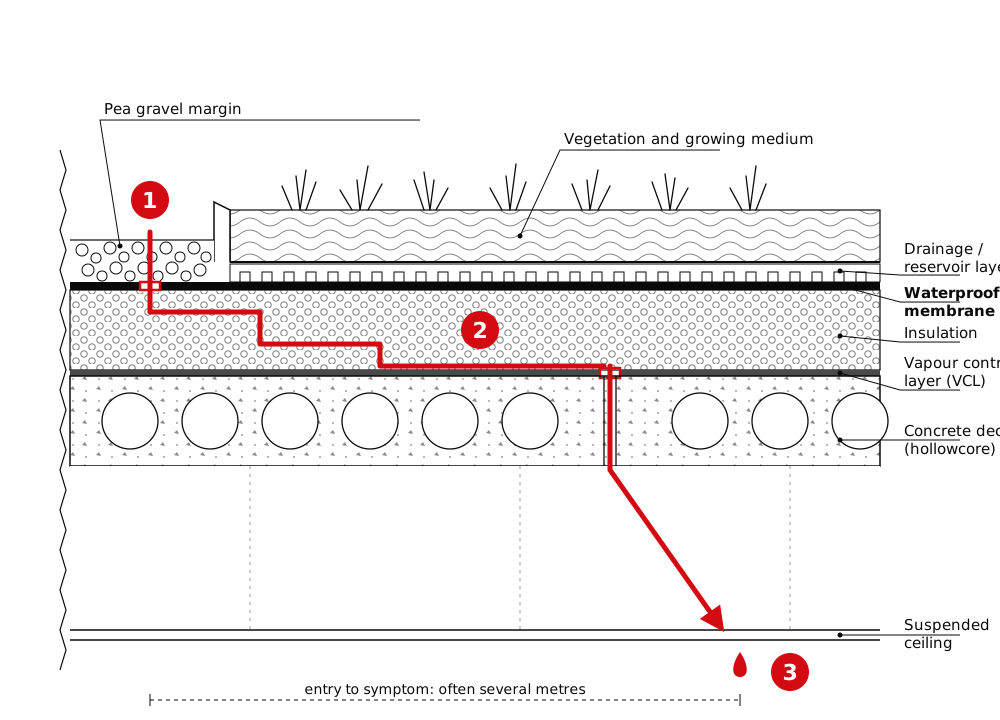
Why green roofs leak
- Concealed mechanical damage during installation. Foot traffic during landscaping, dropped tools, point loads from aggregate and planters. The damage is inflicted before the planting is in; by the time the leak shows, the building is occupied and the contractor has demobilised.
- Detailing. Penetrations and outlets are the commonest defects on any roof. Parapets and flashings, level threshold doors and cavity trays are frequent failures that are checked less often.
- Root penetration, even where a root barrier is specified, if the barrier is missing, damaged or stops short at an upstand.
- Storm loading. A green roof that leaks only in heavy or prolonged rain has a defect ordinary weather never reaches. Water accumulates in the build-up to abnormal depths and exposes it. Why does a green roof only leak in heavy rain?
- Not the roof. Occasionally the water is something else entirely. We recently traced a suspected green roof leak to an escape of water from a radiator system. Establishing cause comes before repairing anything.
Why the standard methods fail
Each of the usual methods assumes you can see or reach the membrane, and each fails on a green roof in a predictable way.
| Method | On an exposed membrane | Under a green roof |
|---|---|---|
| Visual inspection | The starting point | Sees vegetation; finds nothing |
| Thermal imaging | Useful on uninsulated build-ups | Reads surface temperature of wet substrate; nearly never meaningful |
| Dye and flood tests | Confirms a leak | Confirms a leak; cannot locate it, because damming to the membrane is impractical |
| Electronic leak detection (high or low voltage) | The cheap, right option; should be done on every buried roof before covering | Needs the membrane exposed; ineffective through substrate |
| Moisture mapping | Shows wet insulation | Shows where water is trapped in the build-up, not where it entered |
| Buried leak location | Not needed | Built for this: reads the membrane through the build-up |
The through-build-up method is explained in plain words on Can you find a leak without removing the green roof?
What works: buried leak location
A buried leak location survey maps the flow of electricity through the roof. An electrical source is connected at the point of ingress and the electrical flux is measured across the roof surface in a grid, through the planting and substrate. The result is a contour map on the roof plan showing where conductivity is greatest, which corresponds to the points of ingress; the breach shows as a clear anomaly at a highly localised position.
Nothing is stripped. Two of the Vector team attend, usually for two consecutive days. The roof has to be leaking while it is measured, so the leak is recreated by watering the deck beforehand. The report follows about two weeks later; we talk it through and agree where to open up, typically about a square metre at each marked location; and we attend when the membrane is exposed to confirm the defect and witness the repair. Multiple waterproofing layers, slip layers and certain vapour control layers can make the survey ineffective, which we establish from an initial inspection before quoting.
At an occupied extra-care building in Derbyshire, leaks that had persisted under the green roofs for years were located this way and repaired with minimal disruption to the residents living underneath: Darley Dale. At an integrated green roof with a solar array in Balham, where dye and electrolysis testing had failed, the survey plotted two suspicious areas against the leak reported in the flat below and the contractor opened up there and only there: The Tramyard.
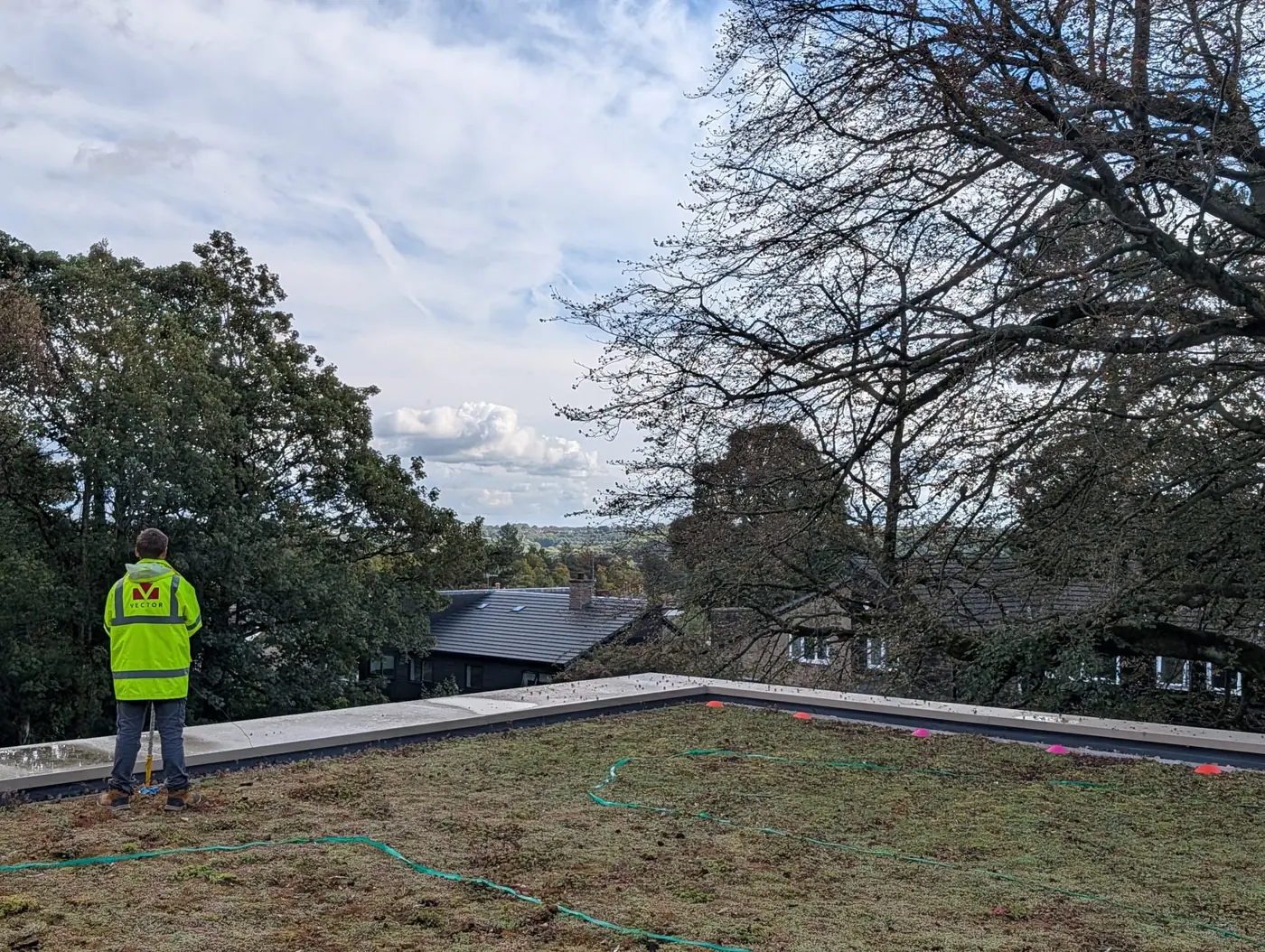
The service, step by step: Buried Leak Location.
Before the roof is covered: integrity testing
Standard electronic leak detection requires direct membrane access, and on a green roof that is gone the moment substrate is loaded. So it should be done while access exists. Pre-handover electronic integrity testing on the bare membrane, before the overburden goes on, is now expected by NHBC, Premier Guarantee and LABC on buried-membrane roofs, and BS 6229:2025 calls for integrity testing before temporary protection is installed and again after it is removed. An independent test at that point is the cheapest leak investigation a green roof will ever have. Electronic leak detection: the complete UK guide.
Making it the last time: permanent monitoring
The best protection is to build the roof so that it can be asked where the water is. Moisture sensors placed in the build-up beneath the waterproofing, on the vapour control layer, report continuously; water that reaches the deck is detected and narrowed to a defined zone with a dated record, and nothing has to be opened up to ask the question. On an existing green roof they can be retrofitted by coring through the build-up, and the ideal moment is while the roof is already open for a located repair: straightforward, not particularly expensive, and the thing that restores confidence after an intermittent leak has eroded it. Smart roof monitoring: what it is, how it works and what it cannot do.
What to do if your green roof is leaking
- Map every visible point of ingress on the roof plan and note the weather dependency: during rain, hours after, heavy rain only.
- Do not assume the leak is above the ingress point. It almost certainly is not, and lifting planting there disturbs sound waterproofing.
- Do not accept a previous repair as evidence that an area is sound until it has been tested.
- Engage an independent specialist before commissioning remedial work, and keep the leak reproducible: the survey needs the roof leaking while it is measured.
- Have the same specialist witness the opening-up and the repair, and ask whether sensors should go in while the roof is open.
If the roof has just leaked after a storm, start with Green roof leaking after heavy rain: what to do, written for the facilities manager, asset manager or surveyor dealing with it this week. The full owner’s guide, with section diagrams and a real survey result, is How can I find a leak in a green roof?
Related reading
- Green roof leaking after heavy rain: what to do
- Why does a green roof only leak in heavy rain?
- Can you find a leak without removing the green roof?
- Green roof leak survey: what a building surveyor should specify
- How can I find a leak in a green roof?
- How we approach a roof leak investigation
- Buried Leak Location · Permanent leak detection and sensor monitoring · Roof leak detection and condition surveys
If your green roof is leaking, talk to Vector.