

Yes. A green roof leak can be found without removing the green roof. A buried leak location survey reads the waterproofing membrane through the planting, substrate and drainage layer and plots the breach on the roof plan. The only opening-up is a small marked area, typically about a square metre, to expose the defect and repair it. This page explains how that is possible, what the survey needs from you, and the handful of situations in which it cannot be done.
The question usually arrives after a roofer has already lifted the planting above the wet ceiling, found sound membrane, and put it back. That is not the roofer’s fault: on a green roof the water showing on the ceiling has usually travelled a long way sideways from where it got in, so the membrane above the stain is probably fine. The problem is that nobody can see the membrane anywhere else either, and stripping a whole roof to look is expensive, disruptive and damaging to waterproofing that was sound.
How the survey works, in plain words
Buried leak location maps the flow of electricity from one side of the roof to the other. An electrical source is connected at the point of ingress, where the water is showing inside the building. The electrical flux is then measured across the upper surface of the roof in a grid, through the planting, the substrate and the drainage layer, with the survey team walking the roof. That is a large simplification of a method that takes a good deal of analysis afterwards, but it is the essence of it.
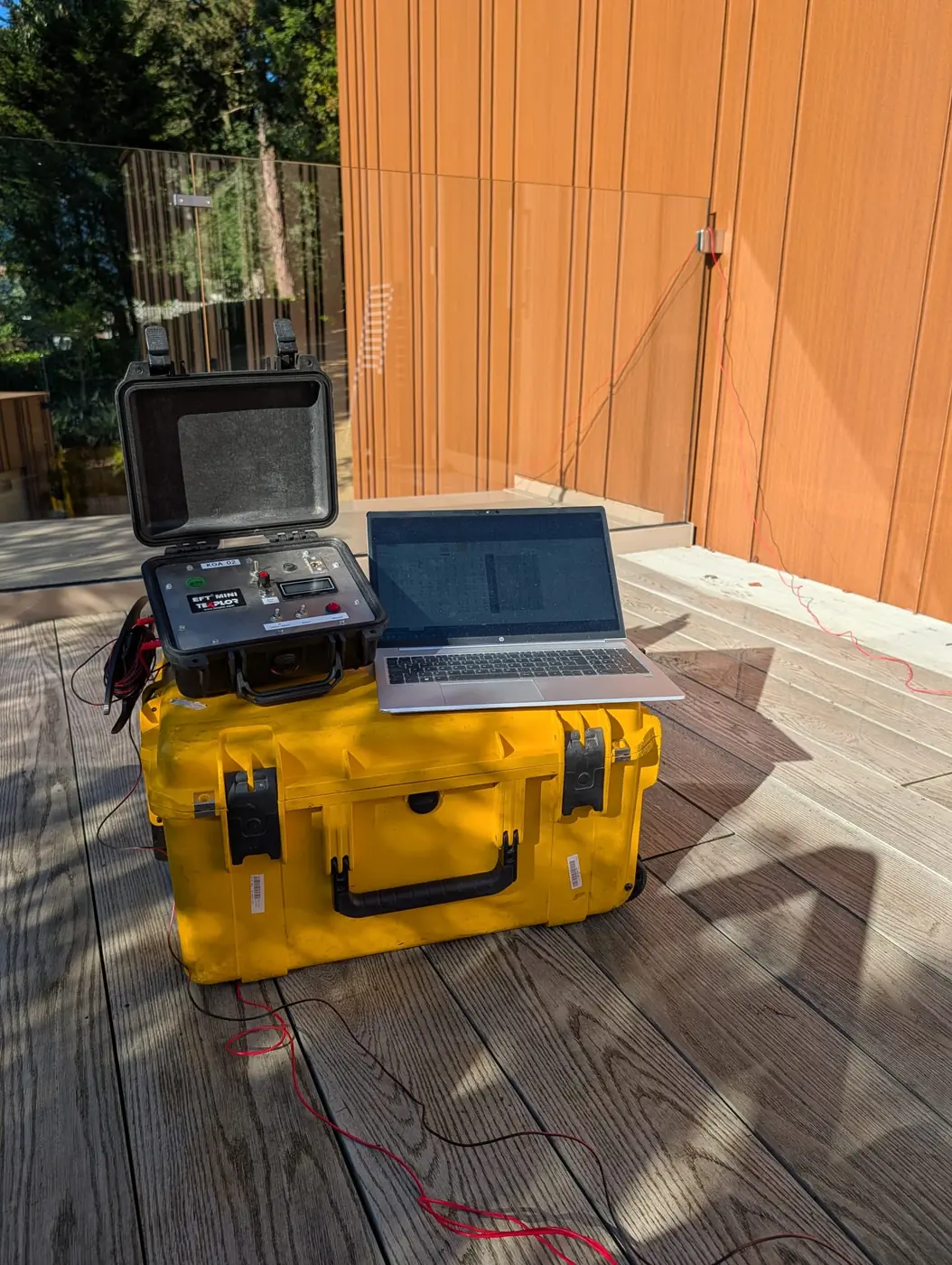
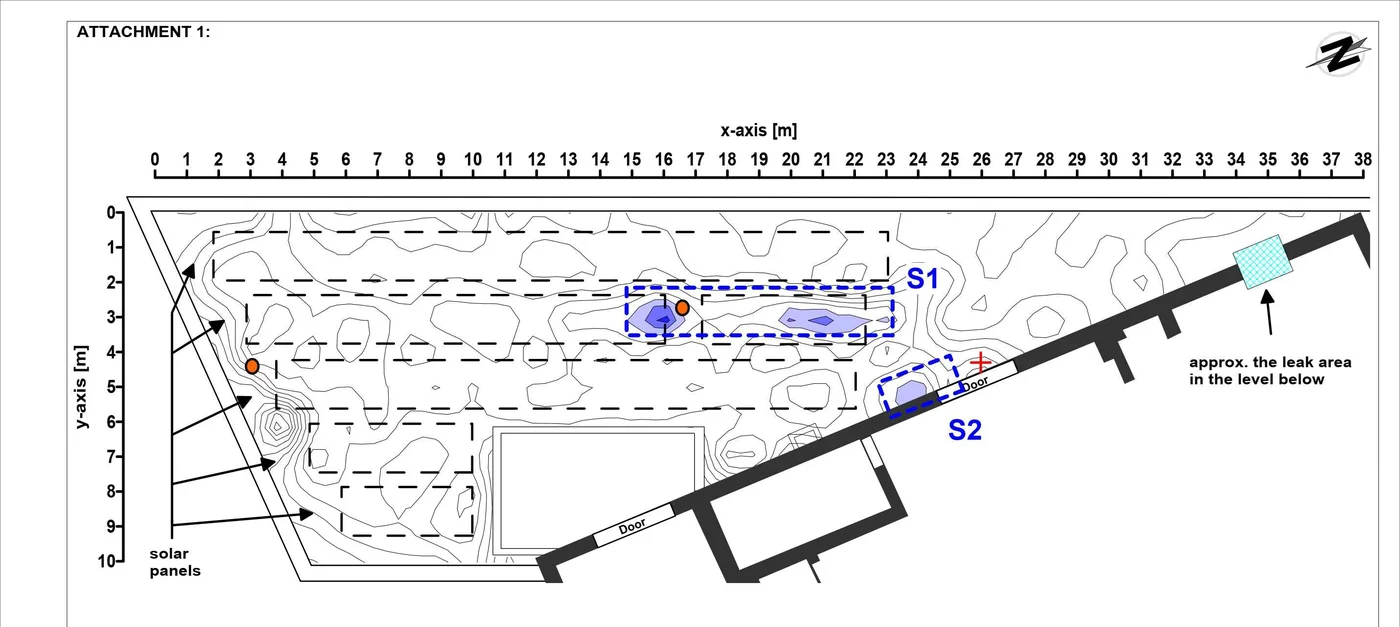
Water passing through a breach in the membrane makes that path conductive. The outcome of the survey is a contour map laid over the roof plan showing where conductivity is greatest, and those points correspond well with the points of ingress. The breach shows as a clear anomaly at a highly localised position.
What it needs from you
The roof has to be leaking while it is measured. This is the one condition that matters. If the leak cannot be recreated, the survey cannot be done. So before we are instructed to attend, the facilities team recreates the leak by watering the deck, with leak diverters in place below; we give guidance on how to do it and the equipment that helps, sometimes as simple as a timer on a tap. We only want to attend once the leak is running. After a storm this condition is usually easy to meet, which is one reason a storm is the right moment to get the survey done rather than the wrong one.
Access and permissions. Two of the Vector team attend, usually for two consecutive days. We do not normally need to move any planting; if we did, it would be discussed in advance and preferably carried out by the facilities team. Where the people under the roof are not the people responsible for it, written permission for access and for the watering needs organising early.
The build-up. Send the as-built details and O&M information with the roof plan, the points of ingress marked and the maintenance record. We review that first and tell you whether the survey is viable for this roof before anything is quoted.
What you get back, and what happens next
A professional report, typically two weeks after the site days, whose main deliverable is the contour map showing leak locations and any suspicious areas. We follow it with a call to talk it through and agree where localised opening-up will be carried out. Typically that is a minimum of about a square metre around each marked location, because even once the defect is found there has to be room to carry out a proper repair.
Then the step that should never be skipped: we want to be instructed to attend once the membrane is exposed, to investigate, identify the point of ingress and carry out quality assurance on the remedial works. The building owner, the roofer, the waterproofing supplier and the occupants all want certainty, and that certainty is lost if the opening-up and inspection is carried out by somebody who is not independent and not expert. If the build-up suits, this is also the ideal moment to put in a moisture sensor, so the roof reports on itself from then on.
At an occupied extra-care building in Derbyshire, leaks that had persisted under the green roofs for years were located this way and repaired with minimal disruption to the residents living underneath: Darley Dale.
When it cannot be done
Honest limits, because they are the difference between a survey and a wasted two days.
- Multiple layers. Multiple waterproofing layers, slip layers and certain vapour control layers can make the survey ineffective. Blue roofs, and green roofs over blue roofs, are the most awkward; podium decks with slip layers complicate the readings; an inverted roof is often simpler provided the relevant layer can be reached.
- No leak to recreate. If the roof cannot be made to leak on demand, there is nothing for the survey to read. We would rather wait for wet weather than attend a dry roof.
- Planting too dense to measure. If we cannot get a decent measuring grid across the surface, the readings suffer. This is rare and is usually solvable with the landscaper.
None of these is a reason to start digging. They are reasons to establish viability first, which we do from the initial inspection.
Which method, when
Thermal imaging is nearly never the right call on a green roof; it only shows something meaningful on a build-up with no insulation. Visual inspection is the starting point wherever the waterproofing can be seen. Electronic leak detection is the cheap and right option where the build-up suits it and the membrane is exposed, and it should be done on every buried roof before the overburden goes on. The moment the roof would have to be stripped to reach the membrane for electronic testing, buried leak location is bound to be the better option. Dye and flood tests can prove a roof leaks but cannot say where, because damming down to the membrane through a green roof build-up is impractical.
Related reading
- Green roof leaking after heavy rain: what to do — the first week, for facilities and asset managers
- Why does a green roof only leak in heavy rain?
- Buried Leak Location — the service, step by step
- How can I find a leak in a green roof?
- The Tramyard, Balham and Darley Dale
If you would rather locate the defect than dig for it, send the roof plan and the as-built details and talk to Vector.