

A green roof that leaks only in heavy or prolonged rain has a defect that ordinary weather does not reach. In a storm, water accumulates in the build-up to depths that are not normal, and that depth exposes a breach that has almost certainly been there for a long time. By the time it shows on a ceiling it has usually travelled a long way from where it got in. Understanding why is what stops the next repair being in the wrong place.
Water has to get through every layer first
Think of a green roof as a stack of layers, each of which slows water down. Vegetation and substrate absorb it. A filter fleece and a drainage layer move it sideways towards the outlets. Many green roofs include a water flow-reducing layer, designed to hold water back for attenuation, which in itself is close to waterproof. Only below all of that is the waterproofing membrane.
In ordinary rain, water passes through the substrate, drains away through the drainage layer, or evaporates before it accumulates on anything. It never reaches the membrane in any quantity, let alone at any depth. A small defect in the membrane stays dry.
In heavy or prolonged rain the drainage layer cannot keep up and water accumulates. It reaches depths in the build-up that are not normal, it sits over the membrane under a head of water, and that depth exposes a defect in a way that everyday weather never does. The roof has not failed in the storm. The storm has found a failure that was already there.
And then through every layer below
The membrane is not the last layer. Below it, water has to make its way through the insulation, the vapour control layer and the structure before it can show inside, and each of those slows it down too. In dry weather, water that has got past the membrane often evaporates before it becomes apparent. So the leak can be long-standing and simply not show up often. It needs enough water, arriving fast enough, to get all the way through before it dries.
This is why a storm can produce a “new” leak in a roof that has been quietly admitting water for years, and why the first sign of it is often a stain that was not there last week on a ceiling that has been under the same roof for a decade.
Drainage behaves differently in a storm
The layers are only half of it. A blue roof is the clearest example, because its drainage is designed to behave differently in different weather: it holds water back deliberately. But any green roof with a restricted or partly blocked outlet will hold water in a storm that it sheds in a shower, and a roof that has stood with water over its membrane for a day will find defects that a roof draining freely never does. Outlets and overflows are among the first things to check, and among the most often neglected.
Why the stain is not where the hole is
Water moves horizontally through a roof build-up as readily as it moves down. Above the membrane, the drainage layer is designed to carry it sideways to the outlets. Below the membrane, it runs along the top of the insulation, through the joints between boards, along the vapour control layer and down the falls of the deck, and it keeps going until it finds a route through to the space below: a construction joint, a service penetration, a movement joint, a crack, a low point. That is where the ceiling gets wet.
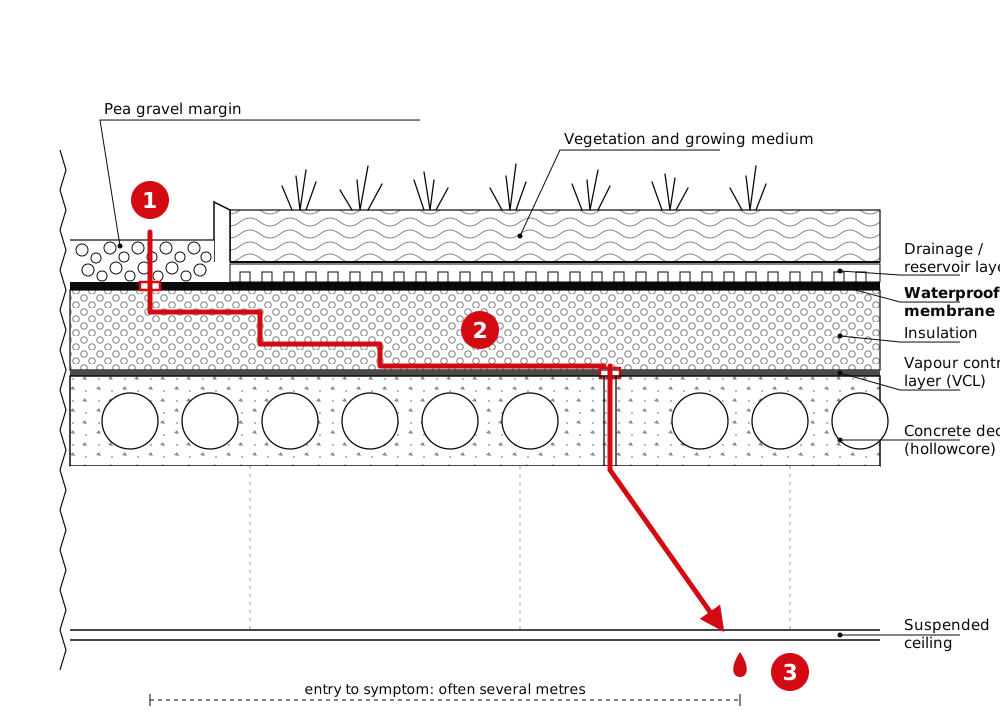
How far depends on the build-up and the falls. The more layers there are, the further water can move. On a large deck we would expect anything from ten to fifty metres between the breach and the point of ingress; it is hard to get much further than that. Vertically it can be worse. We are investigating a building now where the defect is at level six and the water is showing at level four, two floors below the roof it is coming from.
The practical consequence is blunt. If a contractor lifts the planting above the wet ceiling and finds nothing wrong with the membrane, the membrane there is probably fine, and the hole is somewhere else. Opening up above the drip is the most common first move and the least likely to find anything.
Where the defects usually are, and the one that is hard
By the time Vector is involved, the obvious things have normally been looked at. Penetrations and outlets are the commonest defects on any roof and are usually checked first. Parapets and flashings, level threshold doors and cavity trays are frequent points of failure that are checked less often. Not every leak is the roof: we recently traced a suspected roof leak to an escape of water from a radiator system.
The hard case, and the one where an independent specialist earns their fee, is a defect somewhere in the field sheet of the membrane, under the full depth of the green roof, with nobody able to say where. That is what a buried leak location survey is for, and it is explained on Can you find a leak without removing the green roof?
Why the patch did not work
When nobody has established cause, the normal sequence is a visual inspection of what is accessible, a patch on something plausible, and exposing and repairing above the stain. On a warm roof it is common for water to be accumulating on the vapour control layer and finding a defect there, so a patch on the waterproofing above the drip does nothing. The roof is covered back up, and however many months later it leaks again in the next storm, and nobody can say whether the repair was effective. Patch repairs are also, far more often than you would believe, poorly carried out and leak themselves.
Once occupants anticipate a leak every time it rains, trust goes, and with it goodwill, and the repair gets harder and more expensive to achieve. Establish cause first; prove the repair afterwards.
What to do with a heavy-rain-only leak
- Record every ingress position on the roof plan, with the weather pattern: during rain or hours after, how heavy, how long, first time or repeat.
- Check outlets and overflows are clear before anything else.
- Do not lift planting above the wet patch, and do not accept a patch repair as a fix until it has been tested.
- Keep the leak reproducible. A location survey needs the roof to be leaking while it is measured, and a heavy-rain-only leak has to be recreated by watering the deck. Storm season is the right time, not the wrong one.
- Get the membrane surveyed through the build-up by an independent specialist, and have the same specialist witness the opening-up and the repair.
Related reading
- Green roof leaking after heavy rain: what to do — the first week, for facilities and asset managers
- Can you find a leak without removing the green roof?
- How can I find a leak in a green roof?
- Roof leak investigation methodology
- Smart roof monitoring: what it is and what it cannot do — so the next storm is a notification, not a ceiling
If your green roof leaks only when it rains hard, that is the roof telling you where to look. Talk to Vector while the leak can still be recreated.