

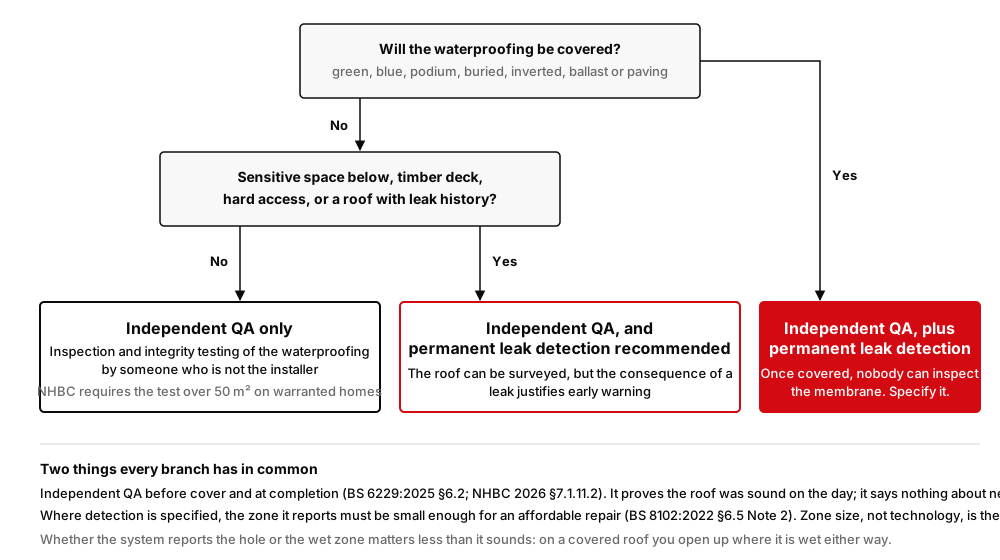
If the waterproofing will be covered, specify permanent leak detection. Green roof, blue roof, inverted roof under ballast or paving, podium, buried deck, landscaping: once the membrane is covered nobody can inspect it, and a sensor is the only way to know it is leaking before the space below does. Also specify it on an exposed roof where a leak would be severe: a data hall, archive, hospital or server room below, a timber deck, or a refurbishment with a leak history. On a low-rise, accessible, exposed membrane with a working maintenance regime, the answer is no.
Every roof, covered or not, gets independent quality assurance of the waterproofing: inspection and integrity testing by someone who is not the installer, before cover and at completion. On NHBC-warranted homes over 50 m² the test is required anyway.
Vector has a commercial arrangement with Sensor Innovation: where we design a sensor array, the design is registered with Sensor Innovation and the client can buy the hardware at a discount. We do not sell or distribute the equipment. That is a potential bias, and we state it so you can weigh it. Ben Hickman is a co-author of CIRIA C817 (blue roofs) and of the PCA’s guidance on buried roofs, both cited below. This page is meant to be equally useful whether you end up specifying a sensor system, a breach-locating grid, independent QA only, or no detection at all.
The real question is: if this roof leaks, how will anyone find out, and how will anyone find the hole? If you are still deciding the build-up, read high-risk flat roof: how to reduce the risk first.
Which roofs need leak detection?
Two things decide it: whether anyone will be able to see the membrane once the roof is finished, and what an undetected leak would cost. The first is a rule. If the waterproofing is covered, the roof benefits from permanent leak detection, because inspection is no longer an option and the alternative is waiting for the ceiling below to tell you. The second is a judgement about consequence.
In the cards, “independent QA” means inspection and integrity testing of the waterproofing by someone who is not the installer, before cover and at completion. “Permanent leak detection” means sensors or a grid left in the roof that report water arriving.
Exposed, accessible warm roof, low rise
- If it leaks
- Wet insulation, internal damage
- Finding it
- Easy: survey from above
- Specify
- Independent QA only
The roof can be walked, surveyed and repaired.
Inverted roof under ballast or paving
- If it leaks
- Water sits on the membrane; leaks surface late
- Finding it
- Hard: ballast or paving lifted to survey
- Specify
- Independent QA plus permanent leak detection. The membrane is covered.
A protected membrane, but out of reach once covered. The wet zone tells you which bay to lift.
Green or biodiverse roof
- If it leaks
- Saturated substrate feeds the leak; repair means removing vegetation and substrate
- Finding it
- Hard to very hard
- Specify
- Independent QA before cover (NHBC requires the test on warranted homes), plus permanent leak detection
Opening a green roof to find a hole costs more than the detection.
Blue roof (warm)
- If it leaks
- Standing water on a zero-fall roof finds every defect
- Finding it
- Very hard: C817 says potentially wholesale removal of overburden
- Specify
- Independent QA plus permanent leak detection (CIRIA C817 §3.2.3: should be considered)
The clearest case where UK guidance names permanent detection.
Podium or buried deck
- If it leaks
- Water into basements, car parks, plant; access often impossible
- Finding it
- Very hard: the PCA says access remains the major difficulty
- Specify
- Fully bonded waterproofing on concrete first; independent QA; plus permanent leak detection. Where the waterproofing is not fully bonded, detection is what makes the design acceptable at all (BS 8102:2022 §6.5 Note 2), and the PCA warns it gives limited identification (PCA §5)
Bond limits travel; detection tells you the roof is leaking while there is still a choice about what to do.
Roof over a data centre, archive, hospital or server room
- If it leaks
- Loss of contents or service, not just fabric
- Finding it
- Depends on build-up; the consequence decides
- Specify
- Independent QA plus permanent leak detection, covered or not
Early warning matters more than the roof.
CLT or timber deck
- If it leaks
- Decay in the structure. NHBC does not accept CLT flat roof decks on warranted homes
- Finding it
- Hard: electrical test methods are marginal on timber, so the QA method must be agreed at Stage 3
- Specify
- Independent QA plus timber moisture monitoring as one way of meeting BS 6229:2025 §5.2, which asks for scheduled inspection and testing of CLT decks during construction and in service
The deck itself is the thing at risk.
Precast plank or composite metal deck
- If it leaks
- Water travels along joints or troughs and appears far from the hole
- Finding it
- Hard: the wet patch misleads
- Specify
- Independent QA; permanent leak detection if covered, and worth considering even if not
C817 §3.26.5: these decks hide defects.
Complex geometry, many penetrations
- If it leaks
- More details, more chances of a defect
- Finding it
- Moderate exposed; hard once covered
- Specify
- Independent QA as a minimum; permanent leak detection if covered or the space below is sensitive
Defects cluster at details and upstands.
Refurbishment of a roof with leak history
- If it leaks
- The same leak returns, with no record of where
- Finding it
- Hard: layered history, unknown build-up
- Specify
- Independent QA of the new work, plus permanent leak detection (retrofittable point sensors if the roof cannot be stripped)
You already know this roof leaks.
Electrical integrity testing needs a conductive path beneath the membrane. Black EPDM, foil-faced bitumen, decks isolated by a vapour control layer and most timber decks defeat or degrade it (CIRIA C538 §5.3; NHBC 7.1.11.2; CIRIA C817). A conductive underlay is sometimes offered as the fix. Our view is that it adds little: on an inverted roof the membrane already sits on a concrete deck, and on any covered roof the wet zone is what tells you where to open up, whichever layer reported it. If the build-up cannot be tested, change the build-up or agree a different QA method at Stage 3; do not rely on an underlay to rescue a design. Bond and deck choice come first: see what is the most robust flat roof waterproofing system?
Is leak detection required by NHBC or BS 6229?
Permanent leak detection is not required by any UK standard or warranty body that we know of. Integrity testing, which is the core of independent QA, is a different matter.
| Document | What it says | Status |
|---|---|---|
| NHBC Standards 2026, Chapter 7.1 | 7.1.11.2: roofs over 50 m², or difficult to access (for example over three storeys), get a visual inspection plus an appropriate integrity test by a suitably qualified surveyor, with a report and photographs made available to NHBC; EPDM and foil-faced bitumen may be visually inspected with seam probing instead. 7.1.2: the test method is stated in the design information. 7.1.12: green roofs tested before covering. 7.1.6.1: CLT panels not accepted for flat roof construction. | Requires warranted homes |
| BS 6229:2025 (current from 31 December 2025) | Code of practice. 6.1: electronic leak integrity testing is among the compliance tests to agree. 6.2: test before temporary protection goes on and again after it is removed. 5.2: CLT decks designed out wherever possible; if used, inspected or tested in service. 8.2: inspections at least twice yearly and after extreme weather. No recommendation for permanent monitoring. | Recommends |
| CIRIA C817, Blue roofs (2024) | 3.2.3: on warm blue roofs leaks are extremely hard to locate and repair; a permanent leak detection system (passive or automatic, with telemetry and defect-location grids) should be considered. 3.26: repairability, including the ability to locate defects, is a key criterion. 3.26.5: precast planks and composite metal decks hide defects. | Should be considered |
| BS 8102:2022, §6.5 Note 2 | Accepts warm roof build-ups and loose-laid waterproofing on buried decks where permanent leak detection is employed such that leak locations can be identified and repairability is achieved. | Enables does not require |
| PCA Buried Roofs Below Ground Level (Dec 2024) | §5: fully bonded on a reinforced concrete deck is the only option where inaccessible; where not fully bonded, permanent leak detection may be considered, but it gives limited identification and access remains the major difficulty. | May be considered |
| LRWA Guidance Note 18 (2025, V1.1 June 2026) | Electronic integrity testing of liquid-applied membranes; timing before green roof, paving or decking. Nothing on permanent monitoring. | Industry guidance |
| ASTM D7877-25; ASTM D8231-24a | US method guides for electrical leak detection and low-voltage scanning; D7877 states the need for a conductive substrate. | Method standards |
In short: NHBC requires the test on warranted homes above 50 m² or where access is difficult; BS 6229:2025 recommends two tests on any flat roof; permanent detection is a design decision, with C817 the document to cite on a warm blue roof and BS 8102 the one to cite on a buried deck. The standards say “integrity test”. We say independent QA, because a test commissioned and witnessed by the installer proves less than the same test run by someone who answers to the client.
What is the difference between independent QA and permanent leak detection?
Independent QA proves the waterproofing was sound at a moment and, if it was not, finds the hole while the roof is still open. Permanent leak detection stays in the roof for the life of the building and reports water arriving at a sensor, or a breach being bridged. A covered roof needs both: QA alone says nothing after the day the landscaping went on; detection alone may be commissioned over a defect and record it as normal. See permanent monitoring vs electronic integrity testing.
When in the RIBA stages should leak detection be decided?
With the build-up, at Stage 3. Grids and sensors sit on the vapour control layer, and their positions depend on the insulation, the falls and where water will collect.
- Concept: flag the risk
Roofs that will be covered, roofs over sensitive spaces, timber decks, refurbishments with leak history.
- Spatial coordination: decide build-up and detection together
Covered roof: independent QA plus permanent leak detection. Exposed roof: independent QA, with detection where the consequence justifies it. Agree the QA method against the build-up, and who pays for monitoring after handover.
- Technical design: write it and draw it
Monitored extent, the zone size an alarm must resolve to, sensor or grid density, gateways and power, the no-penetration rule, the QA regime and who carries it out. Model text in NBS specification for roof leak detection.
- Construction: QA, QA again, commission, baseline
Independent QA before cover. Again after temporary protection is removed (BS 6229:2025 §6.2). Commission detection before the waterproofing is concealed, after the QA has passed. Record a baseline for every zone.
- Handover: records and a named owner
Zone map, as-installed positions, baseline, QA reports with photographs (NHBC 7.1.11.2), guarantee confirmation in the owner’s manual (BS 6229:2025 §8.1 covers the records), plus a named alarm owner, which is Vector’s recommendation rather than a clause.
- Use: inspect and monitor
Inspect twice a year and after extreme weather (BS 6229:2025 §8.2). Monitoring supplements this; it does not replace it.
What will leak detection do, and what won’t it do?
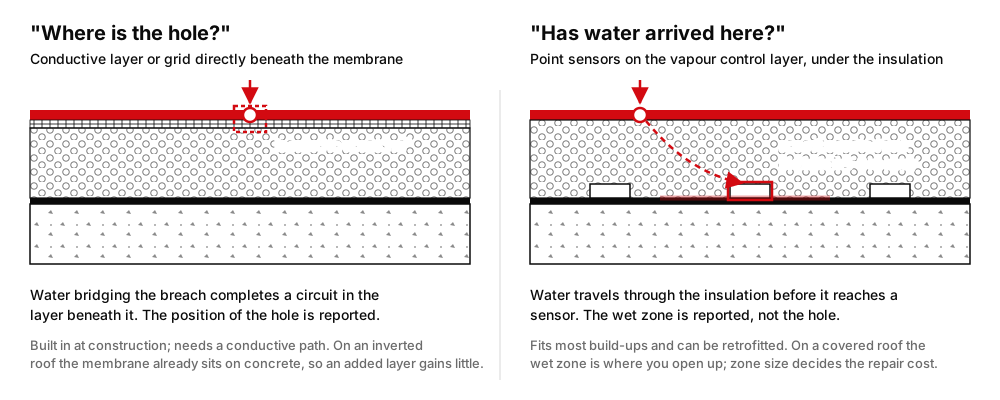
It detects water arriving, or a breach being bridged. A conductive grid at membrane level can locate the breach, typically to around a square metre. Point sensors, and grids laid lower on the vapour control layer, report the wet zone, not where the membrane failed. Either way, what you specify is the zone size an alarm must resolve to, because that is what sets the cost of the repair. The systems are compared in what are the best smart roof leak detection systems?
It will not find a breach that is not admitting water. A defect above the water level is invisible until it is wetted.
It is only as good as its baseline. A system commissioned before construction moisture has dried, or over waterproofing that has not had independent QA, records the wrong “normal”. The peer-reviewed SINTEF field study of two Norwegian roofs fitted with Sensor Innovation sensors, the system Vector designs with (see disclosure), using a warning method SINTEF developed with that vendor (Asphaug, Geving and Moschetti, Journal of Building Physics, 2024), switched automatic warnings off for the first seven to eight months while built-in moisture dried, and its three leaks were found by people reading the data, not by alarms.
It will raise false alarms unless the design handles moisture that is not a leak. CIRIA C538 noted in 2000 that leak-detection systems are prone to false alarms from condensation (§6, Table 6.1). SINTEF found that on sunny days the daily humidity cycle crossed the alarm threshold and had to be suppressed by a time-of-year and weather rule. We have not been able to find independent validation of detection or false-alarm rates for any commercial permanent roof system.
It does not inspect the roof. Sensors do not tell you an outlet is silting up. BS 6229:2025 §8.2 inspections still apply.
Does leak detection affect the roof guarantee?
It can, in two ways. Penetrations: sensors, cables and fixings through the vapour control layer or the waterproofing are a change to the warranted system, and some manufacturers will not accept them unless they have detailed and approved them. Installer: where someone other than the approved roofing contractor installs the detection layer, the manufacturer may want to sign off the sequence.
Written confirmation from the waterproofing manufacturer, before the system is ordered, that the detection does not affect the guarantee; and no penetration of the vapour control layer or waterproofing without the manufacturer’s written approval of the detail.
In the other direction, no UK warranty body that we know of requires permanent monitoring or offers a better guarantee for having it. NHBC asks for the integrity test and report; LABC Warranty’s technical manual says that in certain circumstances the covering will need testing at completion, and its zero-falls policy asks for peel tests and integrity testing. None of them asks for monitoring.
What does roof leak detection cost?
The figures online for “leak detection cost” are domestic plumbing prices. Independent QA is priced by roof area, visits (two under BS 6229:2025 §6.2, plus one before overburden) and access. A permanent system is driven by the technology (a breach-locating grid costs more per square metre than point sensors), the monitored extent, the sensor or grid density, the number of gateways, and the monitoring service after handover. We do not publish prices: the spread between a small exposed roof and a large buried one is too wide for a single figure to help, and a proposal against your roof plan costs nothing.
Against that, an undetected leak under a green roof, podium or blue roof costs the lifting and reinstatement of the overburden to find the hole, the survey, the repair, and whatever the water reached below. Over a data hall or archive, the fabric is the smallest part of the loss.
What should you ask a leak detection supplier?
- Breach or wet zone, and to what resolution in square metres?
- Compatible with this build-up: membrane, deck, vapour control layer, insulation, overburden depth, standing water?
- Does anything penetrate the vapour control layer or waterproofing, and will the membrane manufacturer confirm in writing that the guarantee is unaffected?
- Alert latency, from water arriving to a person being told?
- How does it separate a leak from construction moisture, condensation and seasonal humidity, including the months after roof closure?
- What independent evidence: certification, field studies, published detection and false-alarm rates?
- Can it serve as the means of the integrity tests, with an independent third party verifying?
- Battery life at the planned reporting rate, coverage under overburden, and what happens if the network or supplier disappears?
- Who owns the data, how is it exported, and what does monitoring cost after handover?
- Who receives the alarm, and what is the response route?
If the answers to 2, 3 and 5 are vague, the system is not ready for your roof. Sensor density is in how many leak sensors does a roof need? and the reasoning behind each clause in specifying an integrated leak detection system in a roof build-up.
Questions architects ask
Is roof leak detection worth it?
It is worth it where the cost of finding a leak without it is high. On an exposed roof a leak is found with a survey. Under a green roof, a podium or a blue roof, CIRIA C817 warns that locating and repairing a leak may require wholesale removal of the overburden. Where the roof can be surveyed in an afternoon, it adds little.
Is leak detection required by NHBC or BS 6229?
Permanent leak detection is not required by either. NHBC requires an integrity test on roofs over 50 m² or difficult to access, with a report to NHBC, and requires green roofs to be tested before they are covered. BS 6229:2025 recommends testing before temporary protection and again after it is removed. CIRIA C817 says a permanent system should be considered on warm blue roofs.
What is independent quality assurance of a flat roof?
Inspection and integrity testing of the waterproofing by someone who is not the installer and who reports to the client or design team, before cover and again at completion. It proves the roof was sound on the day. It says nothing about next year, which is what permanent leak detection is for.
Does leak detection affect the roof guarantee?
It can if it penetrates the vapour control layer or the waterproofing, or if the installer is not approved by the membrane manufacturer. Get the manufacturer’s written confirmation before the system is ordered. No UK warranty body that we know of requires permanent monitoring, so it does not earn a guarantee either.
When in the RIBA stages should it be decided?
Flag the risk at Stage 2, decide it with the roof build-up at Stage 3, and write the clause and drawings at Stage 4. Sensors and grids go in with the build-up, so a Stage 5 decision is usually too late for anything but retrofittable point sensors.
What is the difference between independent QA and permanent leak detection?
Independent QA is a check that the waterproofing was sound at a moment in time. Permanent leak detection stays in the roof and reports water arriving, or a breach appearing, for the life of the building. Every roof needs the QA; a covered roof also needs the detection. One does not replace the other.
Related reading
- Start here if you are still choosing the build-up: high-risk flat roof: how to reduce the risk
- What is the most robust flat roof waterproofing system?
- Permanent monitoring vs electronic integrity testing
- Smart roof monitoring: what it is, how it works, what it cannot do
- What are the best smart roof leak detection systems?
- How many leak sensors does a roof need?
- NBS specification for roof leak detection
- Specifying an integrated leak detection system in a roof build-up
Vector reviews flat roof designs at RIBA Stage 3, while the build-up and the detection decision are still open. If the answer is “independent QA only”, we will say so. Send us the roof section, or talk to Vector.